
How a generation of young people is learning, creating, and preparing to compete, and what the NextGen AI Alliance should build next.
Across the Goodwall platform, they're already using it: daily, confidently, with a clear eye on opportunity. This report combines a global survey of Goodwall users with a live Youth Think Tank of 25 active participants from Africa, Asia, and beyond, surfacing where youth are in their AI journey, what's working, and what needs to come next.
Youth are increasingly motivated to use AI to earn, create, and compete globally.
The NextGen AI Alliance has built a strong foundation by making AI learning accessible at scale, an essential first step in preparing young people for the future.
As the community grows, there is a clear opportunity to build on this foundation by expanding into more advanced pathways: deeper learning experiences, creator-economy skills, localized applications, and a community that supports learners in turning knowledge into real-world outcomes.
This report equips the NextGen AI Alliance and its partners with actionable insight into three questions:
Launched in October 2025 inside the Goodwall app, this global survey has gathered over 6,500 youth responses from across the globe. Respondents are Goodwall users who have completed the AI Fundamentals training on the platform. The survey covers AI usage patterns, confidence, trust, and learning interests, and provides the quantitative spine of this report.
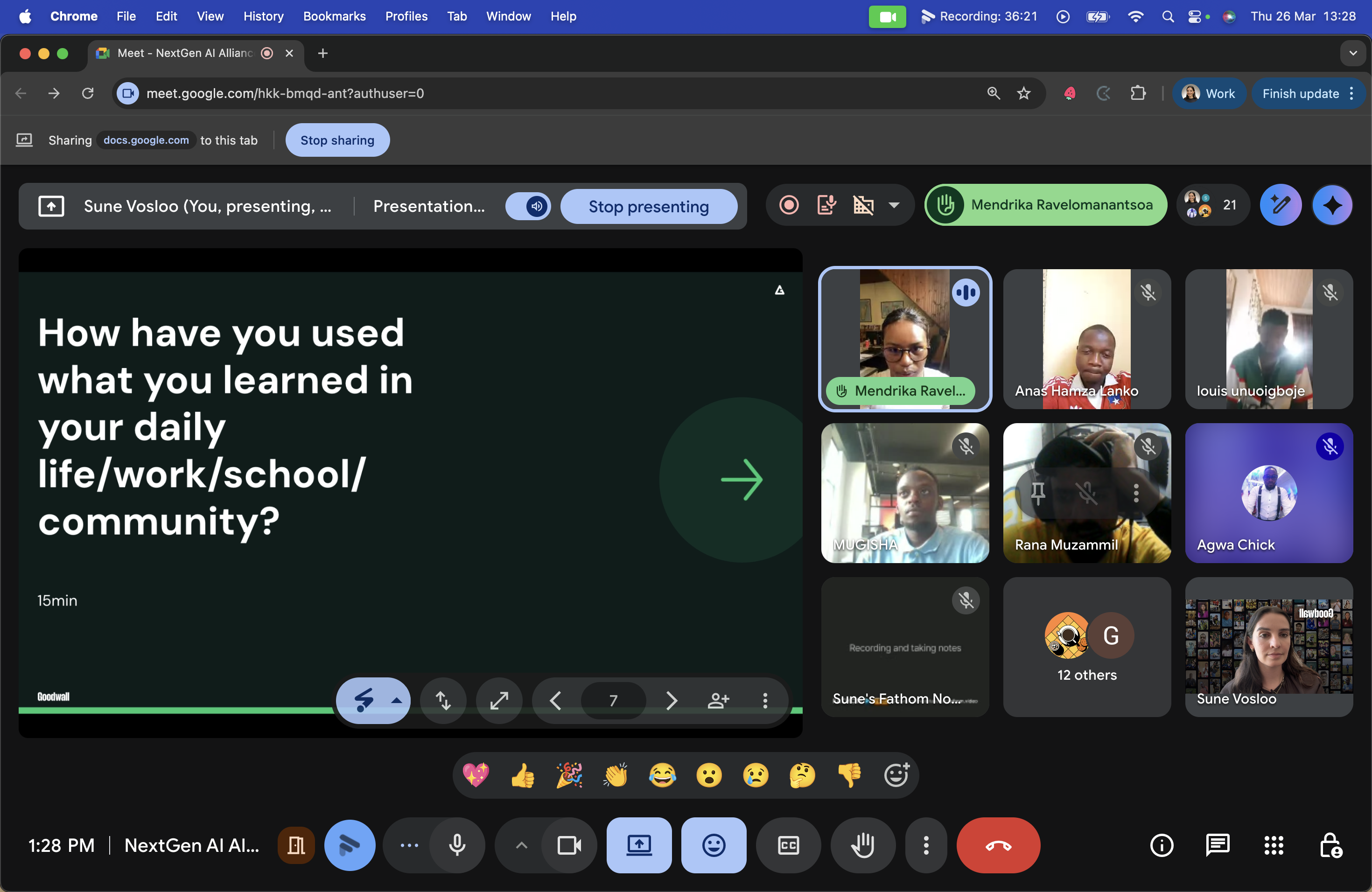
A moderated discussion with 25 active Goodwall users who had already completed AI programming. Participants joined from Nigeria, Rwanda, Kenya, Madagascar, Indonesia, Nepal, and other regions. Their contributions surface lived experience and direct user voice.
The NextGen AI Alliance exists to equip youth with the skills needed to thrive in an AI-driven future. Getting that right means knowing where youth actually are today, how they already apply AI, and what they need to move from learning into opportunity. Much of the conventional wisdom about "youth and AI" underestimates how far they have already come.
Goodwall users are highly engaged with AI tools, and they trust them. Engagement is frequent, confidence is high, and trust in the tools themselves runs ahead of trust in the institutions governing them.
Goodwall users aren't beginners. They are AI-active, confident, and already experimenting with real use cases. The gap between trust in AI tools and trust in the institutions governing them underscores the importance of ethics and transparency in any future programming.
Six Youth Think Tank participants, in their own words.

“To me, AI is a tool for democratizing knowledge for a smarter future in public policy. I would like to see more content on Goodwall that focus on AI Ethics & Sustainability.”

“AI isn’t just a tool. It is a friend and a study partner that help me turn my confusion into clarity, and help me grow into the kind of healthcare professional I want to become.”

“What really worked for me is the Goodwall video format. I can really understand things easily when it’s represented visually. I would like to know if there’s a way to extend the AI programs so that people can dive deeper into the subject.”

“After AI fundamentals, the next step I want on Goodwall is an entry-level cyber security course. That’s the AI-adjacent skill that feels most relevant where I am in Nepal.”

“AI catches the nuances I might miss and gives me the confidence to express my passion for science without a language barrier getting in the way. It’s not about letting the AI speak for me; it’s about using it to find my own voice in a different language.”

“The challenges pushed me to think creatively and apply AI to real-world problems, not just learn theory. What I want to build next is AI that understands human behavior and emotions, especially for mental health.”
Youth sentiment is broadly constructive, but it isn't naive. They expect AI to create new opportunities and reshape jobs in human-centered ways, and they are clear-eyed about the risks they are navigating.
Youth show conditional optimism. They believe in AI's potential, while working through real uncertainty about its impact on jobs and society. That tension is itself a driver of engagement and learning motivation.
Three elements consistently came up in both the survey and Think Tank as the strongest parts of Goodwall's current AI to Opportunity programming.
Practical challenges, real-world problem solving, and interactive formats push users from passive viewing into active use.
The highest-impact skill taught, used across CVs, job applications, teaching, and productivity.
Seen as more structured and guided than YouTube, a meaningful differentiator for users without a coherent path.
"The challenges pushed me to think creatively and apply AI in real-world problems."
Current programming is effective at driving adoption and building initial capability. The foundation is strong, and youth are ready for the next step: deeper learning through Goodwall's partner network, a clearer progression, and more industry- and application-specific pathways.
The same users who praise Goodwall's AI entry experience are clear about where they want to go next. The foundation is working, and youth are ready to go deeper, find clearer pathways into applied AI, and connect those pathways to their industries and communities.
Youth want longer-form content and deeper explanations. Goodwall already delivers this through its partner network. The opportunity is to expand that offering and surface it more prominently inside the app.
Coding modules are where users are most eager for support. A chance to build a more paced, beginner-friendly entry into technical AI work.
Youth want a clearer sense of "what's next" after foundational learning. Goodwall's existing partner programs and opportunities can be mapped into visible, industry- and application-specific pathways.
Goodwall already offers deeper learning opportunities through its partner platforms and opportunity network. What youth are asking for next is to expand those pathways, and to make them clearer, more visible, and more industry- and application-specific inside the app.
One shift came through clearly across both the survey and the Think Tank. Youth are moving past "learning AI" and into "using AI" to create, earn, and solve real problems in the contexts they live in.
47.3% selected better learning and education as what interests them most about AI. Think Tank demand was concrete: AI as a study partner, personalized explanations, project-based learning, and tools that help them turn ideas into real outputs.
29.3% named creativity and innovation. Think Tank demand was clear: AI video creation, storytelling, social media content, and faceless YouTube channels. Youth want AI as a medium for expression.
11.9% selected jobs and new opportunities as a top interest. Discussion surfaced strong underlying demand: freelancing, job applications, and income generation are recurring drivers.
10.9% pointed to solving big challenges (climate change, healthcare, sustainability) as what draws them to AI. This is mission-oriented interest, AI as a tool for impact.
Beyond the survey, three themes ran through the Think Tank: localized & accessible learning (region-specific examples and low-bandwidth solutions), collaboration & community (global peers, group projects, mentorship), and advanced & emerging topics (AI + psychology, ethics, cybersecurity, human–AI collaboration).
awareness · basic use · introduction
income · creativity · real-world outputs
Youth are shifting from "learning AI" to "using AI to create, earn, and solve real problems." Programming designed around outputs, not only understanding, will capture this energy.
The insights in this report, drawn from over 6,500 youth across the globe and 25 Live Think Tank participants, don't reveal a new direction. They validate the one the NextGen AI Alliance has already set. The 2025–2027 path runs from AI foundations at scale, to AI in industry, to youth driving intergenerational AI adoption. Every signal in the research confirms that direction and sharpens how we execute on it.
Launched the global Alliance. Onboarded Founding and Strategic partners. Established strategy and shipped the first foundational AI programs.
Scale impact by expanding geographic reach and widening programming to include human skills and industry-specific learning paths. Deeper collaboration across Alliance partners.
Institutionalize a global ecosystem by partnering with governments to embed AI literacy into national workforce systems.
Read against the roadmap, the research points to three commitments: two that shape 2026, and one that defines 2027.
Youth consistently asked for region-specific examples and solutions designed for low-bandwidth, lower-access environments. Year 2 of the roadmap, AI in Industry, is built around exactly that: expanding geographic reach, translating content, and grounding programming in the realities of the communities young people live in. Localized content is how a global Alliance delivers locally relevant impact.
Across creator-economy skills, freelancing, and real-world problem-solving in climate, health, and sustainability, youth are asking AI programming to move from awareness to application. Year 2 is where that happens: human skills paired with industry-specific learning paths, co-built with Alliance partners, turning interest into capability and capability into opportunity.
The strongest signal in the research, an optimistic, confident, trust-positive cohort of youth, maps directly onto Year 3: Youth Driving Intergenerational AI Adoption. Young people are well placed to carry AI fluency outward to parents and households, teachers and schools, and public-sector institutions in their local contexts. With the right pathways, they don't just learn AI. They lead its adoption.
Youth want to use AI: to earn, create, compete, and then to lead. This report doesn't change the Alliance's course. It confirms it.
The data makes the picture clear. Goodwall users are part of a new generation of AI-native youth: already using AI frequently, confident in its application, and optimistic about its potential.
What they want next is specific:
Youth don't just want to learn AI. They want to use it to earn, create, and compete globally.
The NextGen AI Alliance's role is to close the distance between that ambition and the programming, pathways, and partnerships that make it real.